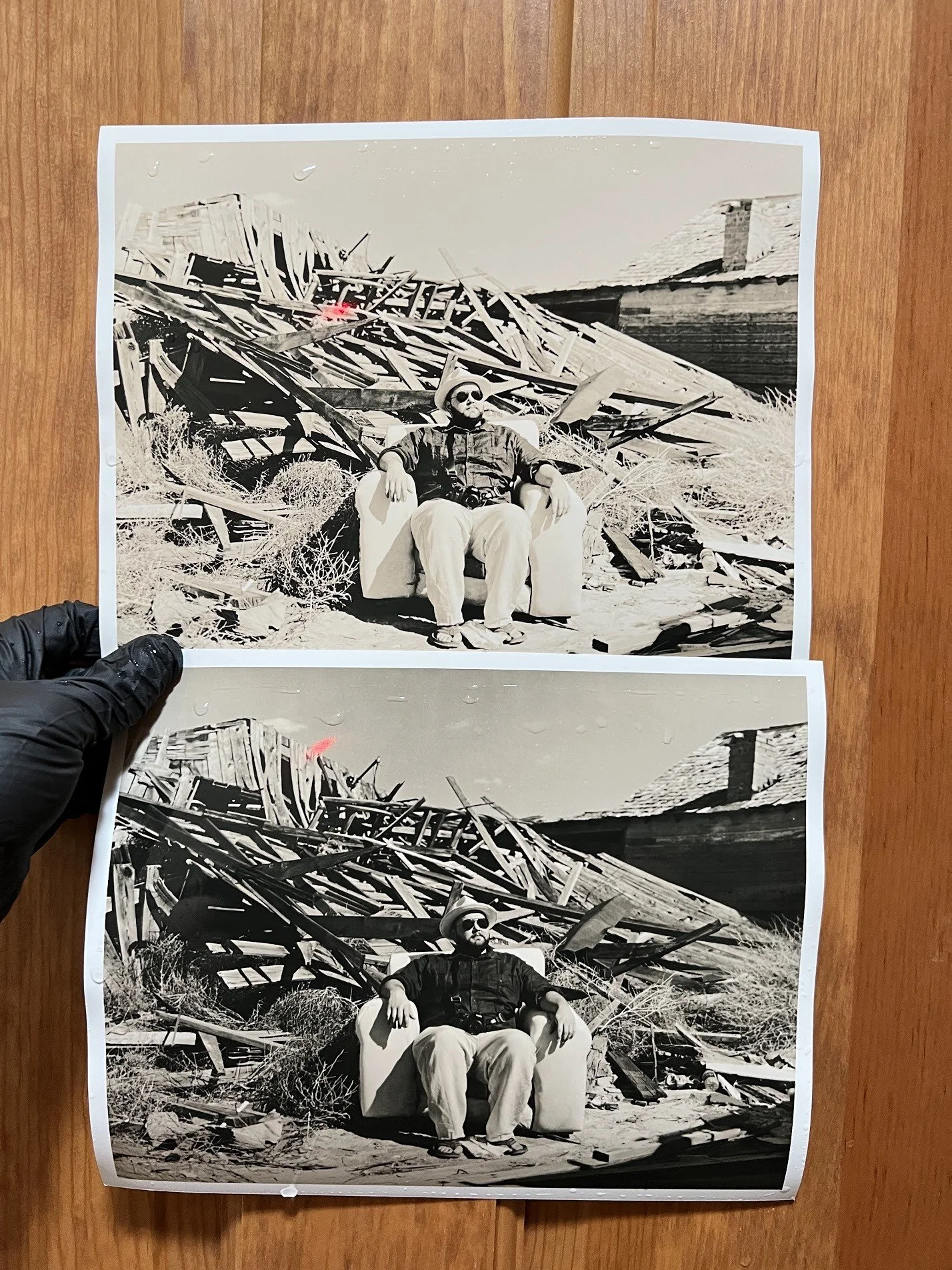
It’ll be a bit figuring out what to do with it though. Happy to be here though!
Research in progress (February 2022)
Hi, just wanted to give a small update to make sure I’m not being too silent on here.
I’ve been doing a series of fairly deep dives into technical research and experimentation lately. The results of this tend to be boring and difficult to discuss much of, but I’ll give a small summary of each project.
I’m working on lith developer formulation and going into a wild new direction. I’m trying to find a suitable sulfite sequestering agent to replace formaldehyde. This has been a rather intense challenge thus far. Acetone DOES work, but the amount required is prohibitive due to the obnoxious odor. I’ve been testing other aldehydes and ketones and combinations to try to increase the potency of acetone, but the ability for these to self-react in alkali has made this a difficult topic to really get a firm grasp on.
I’m also working on general lith developer additives. I have 2 potential additives thus far, both non-toxic and not difficult to source. One is a potential activity increaser and/or sulfite sequestering agent which is not an aldehyde or ketone. The other is a “coloring agent”, specifically it can cause lith developer to produce unique red and pink tones. It does not have this effect in non-lith developers tested. The biggest issue is that there is almost no research of using this chemical in any developer, and it has a tendency to produce fog on many but not all papers and seems to be a potent silver solvent and “displacer”.
Finally, I’m doing a little bit of research on ECN-2 processing technique and alternate processings. I’m wanting to make sure I have a reliable way to remove remjet before shooting anymore ECN-2 film than I already have backlogged. I also would like to create a “hybrid” processing method for ECN-2 which is aimed to produce increased speed, low color saturation, and excellent ability to push develop. Alt processing results thus far has shown some potential, but contrast was too high and color balance was too wonky.
I’m preparing for an extended trip to California later this month where I’ll finally start getting back into real “high effort” photography again. So there won’t be another update on any of this anytime soon, but just know I’m continuing to work and research. I am tossing around the idea of commercialization for some very select formulas, especially GVM1. I’ve also been doing some research of how to go about actually doing that. Unregulated shipping I think I can manage for GVM1, but for many other formulas seems much less clear. How to mix in a more bulk style is not something I’m geared up for, but can likely tackle for prototype runs like what I’m envisioning right now. Later I’ll post and send out a survey for interested parties to be able to express interest and request a sample of some formulas which are known to not be shipping hazards. Keep an eye out for that, but for this month I expect things will be slow on the chemistry front.
Happy New Year! - A newsletter from Grainy Vision
Hi everyone and happy new year! The last email was… (checks notes) almost 2 years ago, but I figured it’s time to break the silence on the newsletter front. There’s been a great number of things done and written about since the previous email, so I’ll only cover the most interesting and the most recent.
Read MoreIlford MGV RC
GVL1 - Long Lasting Warmtone PQ Print Developer
Today I’m introducing an unexpectedly successful developer. I mixed this up just kind of guessing at ratios and just wanting to see what a dilute PQ print developer could do. The actual end result is a formula somewhat reminiscent of ID-78, a warmtone print developer formula created by Ilford, but with notable differences. The end result is a developer with a surprisingly good shelf life, tray life and contrast consistency across its life span. It also is a fairly unique developer producing warmtones which are resistant to going olive colored, instead it will go toward brown tones.
Read More6x4.5 1960s Kodak Plus-X shot at 50 ISO (small amount of age fog). GVM1, dilution A, 71F, 12.5m dev time. Probably used an orange filter
GVM1 - A unique film developer for pushing, portraits, and landscapes
Lately I’ve been doing more regular darkroom printing and this has left me in a bit of a slump. Although I love many of the developer formulations I’ve made, they’ve often not been designed explicitly for darkroom printing. EXG1/GVG1 would produce excellent negatives with increased speed, fine grain, etc… but in the darkroom it was often very difficult to get everything on the negative onto the paper without resorting to lith printing. This problem was only slightly improved with GVK1. GVK6 (yet to be published) has significantly improved this problem, but these developers also reflected the time in my life at which they were formulated. I was doing almost exclusively lith printing and with early ModernLith formulations I needed extended scale and moderately high contrast negatives… So GVK1 specifically was formulated with this aim. EXG1 was formulated when my main priority was getting the best scannable negative, which also benefits from a long density range. And now, I’m doing regular darkroom printing a lot, so it calls for a developer with a new aim.
GVM1 is recommended for:
Extremely smoothed portraits of light skinned people in controlled light
High contrast landscape scenes
Pushing film to use it at increased speed without greatly increasing contrast
Taming the contrast of very high contrast materials
Getting all of the image detail onto a print in the darkroom without great difficulty
Lith Printing Densitometry Placeholder
Ignore this, it’ll be updated later…
Ilford MGV using BasicLith 20+20+1000. Top with PEG-3350 added to increase contrast
BasicLith, a dead simple lith developer formula for modern papers
BasicLith, also known as GVLith #6, is a formula which I created which will from the basis of a series of densitometry measurements in lith printing developer formulations. However, it is likely useful to the general public as well. I specifically designed it for this aim:
Work well with Ilford MGV RC and Fomatone RC papers
Simple to mix with minimal safety concerns, no heating required of flammable solvents
Avoid DMSO because the smell is annoying
A shelf life of at least 1 month (unknown if this developer meets this, but its simple enough to mix that it’s not a problem if not) and tray life of at least 1 hour
As minimal as possible while accomplishing the above goals
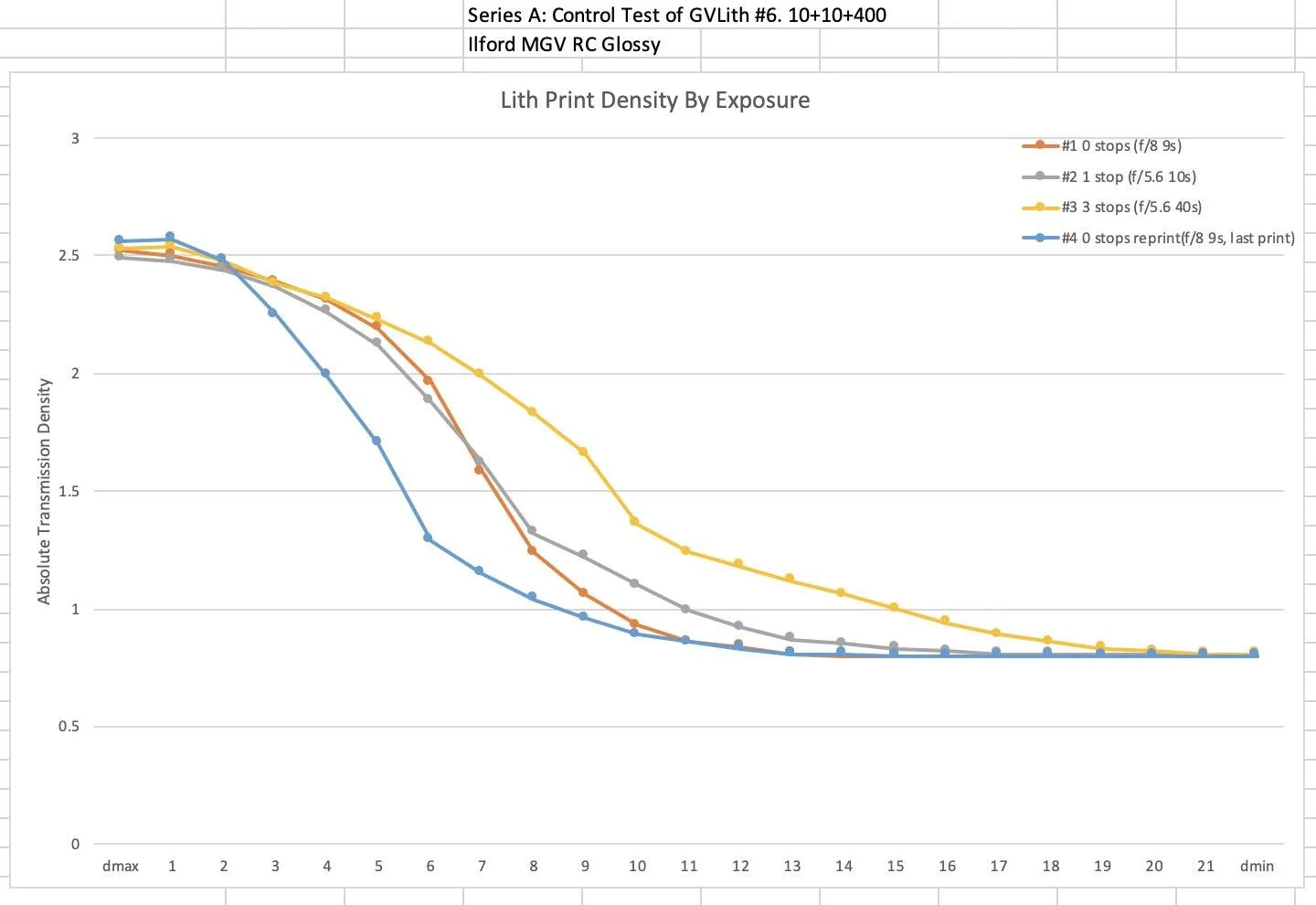
Tray life is not great, expect 1-2 hours typically. To make this formula more controllable for vintage lithable papers, add 0.3-2g of bromide per 10ml of developer parts. This developer may produce fog, pepper fog, or uneven development when heated, and is also much less stable. It is fast enough that heating should not be required. Induction period time with Ilford MGV RC at 74F and 10+10+400 is about 50s, with infectious development starting around 4m30s.
Formula
Part A:
Distilled water, room temperature 40ml
Sodium Metabisulfite 6.6g (note: small amount of SO2 gas released. Don't hold your head over the beaker)
Sodium Bicarbonate (baking soda) 0.7g (add this as soon as the metabisulfite is mostly dissolved. It will bubble quite a bit)
(Optional) PEG-3350, MiraLAX 0.2g
Propylene Glycol 40ml (warmed using a water bath preferably, but not a requirement)
Hydroquinone 11.1g
Top the solution to 100ml using propylene glycol.
Water is avoided for longer shelf life and because glycol is a better solvent for hydroquinone. It is ok if the solution has some very small particles or a tiny amount of "fiber" looking crystals floating around. It should be mostly transparent though and slightly yellow. The remainder will dissolve upon standing for a few hours.
Part B:
70ml water
Potassium Carbonate 13g
Sodium Hydroxide 7.3g (note: make sure your crystals do not appear "wet" or clumpy, this amount is quite precise)
Potassium Bromide 2.7g
Top to 100ml with water
Note: Solution will heat up considerably when adding the carbonate and hydroxide and will be very caustic. Use care and appropriate gloves when handling
Revision: The original version of this formula said to add PEG-3350 to part B. However, this is not possible PEG is practically insoluble in such a concentrated alkaline solution. Instead, it should be mixed into the part A instead. Note that in the part A, it may take a while to dissolve and/or require gentle (water bath style) heating
Usage
Use 10-40ml of each part for 1L of working solution developer, preferably at room temperature. I have only tested equal amounts of each part at a time.
Not an absolute requirement, but I highly recommend making a 1% solution of PEG-3350. PEG-3350 is also called polyethylene glycol of molecular weight 3,350. It is a surprisingly easy to find chemical. It is sold in most countries as a laxative. In the US it is sold under the brand name MiraLax. Use 1-7ml of this 1% solution per 10ml of developer parts for increased contrast and "linearity" of infectious development if not included in part B of the developer. This will increase the linearity of shadow development of the lith developer and gives a general increase in contrast. Certain negatives call for more and some for less, so it may be preferable to keep this as a separate solution for more control.
Spoilers
This is a bit of spoilers and the results still need to be double confirmed, but here is some interesting densitometric measurements using BasicLith without PEG at 10+10+400:
Follow me on social medias!
In case you were not aware, I have a few social channels beyond this blog! On Twitter I kinda talk about everything I’m doing everywhere. On Youtube I focus on long form video content (a series on lith printing is the biggest thing I’m working on). On TikTok I do short form more fun kinda videos and try out shorter stuff that wouldn’t be worth making a “real” video for. Instagram I don’t use much but maybe I’ll get back into it sometime
Twitter: @grainyvision
Youtube: Grainy Vision
TikTok: @grainyvision
Instagram: @grainyvisionphoto
Intermission is done
Still a bit slow getting everything wound back up again, but going to be spending more time with chemistry and in the darkroom. I’m having a bit of a personal dilemma of having less comfort with the previous stuff I photographed (street, travel)… but I’m figuring out how to go forward because I really still love photography. Probably going to be experimenting for a while to figure out what’s fun. Abstract stuff is my current aim for figuring out.
I’ve published a youtube video as well and will begin working on a series there about lith printing: Lith Printing With Modern Materials: Introduction (part 0)
I also have a few different drafts for my blog that need to be finished including GVK3, an improved version of my GVK1 developer, messing around with printing out paper emulsions, and kallitype fun. Either way, I’m finally comfortable and in a place where I can start focusing on hobbies again, so hopefully more stuff is published here soon.
Intermission
I’m not dead. I’ve had to take some time away from film and chemistry. I will be back in a new form later once I figure this out.
Foma Retrobrom (notice edge “drags”)
ModernLithRetro, the short version
ModernLithRetro is a new formulation in my ModernLith developer series. It reverts to a more traditional lith developer formulation, but uses a specific discovery I encountered early on in my experiments. It isn’t quite as versatile or tray-stable as ModernLithEZ, but tends to give more consistent results. It also incorporates allowances for old brown addition to further tune the results and basically give the same general “feel” as a traditional lith developer. It also gives good results on many vintage and modern lithable papers, while also working with a few modern non-lithable papers.
Read MoreKodak 50D
Processing ECN-2 film, in ECN-2 process, at home
ECN-2 film, often known as movie film or cine film, and made widely available in the form of Cinestill branded film, is great for what it is, but using Cinestill film in C-41 always bugged me. The colors always seem a bit off, it comes off as overly grainy, and the lack of antihalation layer on Cinestill really doesn’t work for me in daylight. Also, Cinestill branded film is expensive! Given that I’ve seen movies shot on film, I knew that these problems weren’t the fault of the actual Kodak ECN-2 film itself. It’s due to lack of remjet and cross processing. So, why not just shoot the proper film and process it properly? Well….
Read MoreGVPX1 "Super Solvent" Print Developer for brown tones with modern materials
GVPX1 is a highly experimental/”special” print developer which produces notably warm blacks on nearly all papers, specifically trending more toward brown rather than the olive colors that many warmtone developers give on modern papers. It does this by incorporating a lot of silver solvents in the developer, which effectively eat away at the grains on the paper, making it finer and with the end result of a brown tonation. The exact colors highly depend on the paper as usual, but with most neutral tone papers it will give cold highlights, somewhat olive midtones, and brown shadows. On warmer tone papers, the highights will appear more olive tone and the brown creeps into the midtones some, but unfortunately contrast can suffer due to blacks not being greatly deep. On colder tone papers, it may only appear to have olive colored shadows with no real brown. Basically it depends on the starting grain size of the paper.
Read MoreSome controversial thoughts on film developer contrast
So there has been a number of things I consider myths propagated in the modern film community. There’s also been a number of modern things not properly explored by the photographers of old. I’d like to propose counter theories to these, and give some understanding of how each component in an analog workflow actually relates to the final end result, ie, the print.
Read More6x4.5 FP4+, processed for 11m at 75F
GVK1, a moderate grain, high definition, push capable metol-glycin film developer
GVK1 is a new film developer formulation of a type I’ve never tried before. It was designed with the principles of a high definition developer for high sharpness, while also incorporating enough silver solvent that the grain will not be ugly and outright coarse. It has grain of comparable smoothness to D-76 stock, but to my eye behaves as a speed increasing developer, potentially even providing a speed increase of 1 to 1/2 stop for medium and slow speed films. Contrast is fairly normal with rich shadow detail and slightly compensated highlight detail. Overall shadow and midtone separation is great, but highlights are sometimes at risk of running away, especially if darkroom printing. This developer is especially great for exposure latitude on traditional grain films, with reasonable results coming from box speed processing and between +2 or -2 exposure, though of course more ideal printing density and grain will come with proper pull/push processing. The overall appearance of the developer is extremely sharp, but without the ugly grain that sometimes comes with this, IFF properly developed. Grain specifically here is a very gentle and smooth type where it tends to still be visible but works very well to stay out of the way or even enhance the image. Skies on high speed films can sometimes be a bit much in grain, but that’s pretty par for the coarse. I’d say it can be comparable to the distinct grain that EXG1 gives but quite a bit smoother. It is formulated as a two part recipe for very long shelf life and stability. The significant amount of TEA in solution makes sulfite less soluble so I doubt that this would be suitable as a single part developer.
Read MoreIlford MGV RC - 20+25+1, printed from a long scale and high contrast negative
ModernLithEZ -- An easy to use and mix lith printing developer for modern papers
ModernLithEZ (previously known as ModernLithC3) is a new formulation incorporating a number of discoveries over the past several months to finally formulate an easy to mix and easy to use lith printing developer that is comparable to commercial lith developers, but also works on all modern RC papers which were tested as well as a few modern FB papers. It is split into 3 primary parts and 1 optional part for easy yet highly controllable usage. Note that this developer is only formulated for the specialized process known as lith printing. It is NOT designed for half-tone lith film development.
Read MoreFomaspeed RC in ModernLithC3+PEG prototype
Progress in formulating "Turbo" ModernLithC3
ModernLithC3 is a new in-progress lith printing developer formulation for fast results. This post also includes an update about a complete breakthrough in ModernLith formulation, specifically using the over the counter drug “Miralax” as an easily available and cheap source of polyethylene glycol (PEG) 3350. The addition of PEG allows for unmatched highlight contrast control compared to previous ModernLith formulas. The full prototype formula is included, though it is more dangerous to mix than I’d prefer right now. It develops papers very quickly, but many papers do not respond well at this point. Includes scans and descriptions of the many papers tested.
Read More6x4.5 Plus-X (expired 1964, but somewhat well preserved) with orange filter processed for 13m in EXG3
EXG3, A special use expanded range film developer
This post is a reference post for the custom developer EXG3. EXG3 is a special purpose high contrast and expanded range developer. It gives full speed, but is not ideal for pushing typically. The results it gives are quite unique, though with careful metering required for ideal results. Specifically EXG3 when used properly with slower traditional grain films, will give subtle low contrast shadows, brilliant high contrast highlights, and a very long density range for midtones. The developer also produces moderately fine grain and sometimes exhibits some minor sharpness enhancing edge effects.
Read MoreNew step-wedge scans
Can’t figure out how to bump a blog post here without deleting it and duplicating it, but I’ve updated my previous step wedge post to include scans of all the step wedges from these control tests that I could find. Enjoy! https://grainy.vision/blog/darkroom-paper-step-wedge-references
Fomapan 100 processed in EXG3 prototype v2
Two EXG3 Film Developer Prototypes
Here I write a status update with prototype developer results in making EXG3, an ascorbic acid+glycin film developer designed for expanded range and higher contrast.
Read More