• blog
  • formulas and processes
  • about
  • quarterly newsletter
Menu

Grainy Vision

  • blog
  • formulas and processes
  • about
  • quarterly newsletter
×

Ilford MGV RC

GVL1 - Long Lasting Warmtone PQ Print Developer

Ashley <3 December 16, 2021

Today I’m introducing an unexpectedly successful developer. I mixed this up just kind of guessing at ratios and just wanting to see what a dilute PQ print developer could do. The actual end result is a formula somewhat reminiscent of ID-78, a warmtone print developer formula created by Ilford, but with notable differences. The end result is a developer with a surprisingly good shelf life, tray life and contrast consistency across its life span. It also is a fairly unique developer producing warmtones which are resistant to going olive colored, instead it will go toward brown tones.

Arista FB (same as Fomatone FB)

GVL1 Formula

  • 750ml hot water

  • 10g sodium sulfite

  • 6g hydroquinone

  • 25ml TEA 99% (triethanolamine, sourced from Photographer’s Formulary. Likely low freeze grade)

  • 0.15g Dimezone-S (it is unknown if and how phenidone could be substituted) or 15ml of 1% solution such as 1% dimezone-S in alcohol or glycol

  • 1g potassium bromide

  • 16g sodium metaborate

  • Top to 1L with water

  • Measured pH 10.75

Usage: Use directly with no dilution. Typical development time is 1.5-3m. Keep in airtight bottle in between darkroom sessions

Recommended for: General purpose warmtone paper developer. It’s possible to over expose and under develop to give extremely warm brown tones with this developer, but only if deep black tones are not required.

Characterization: Produces warm tones. Trends more toward browns rather than greens. Produces slightly warm black tones and gives a mostly neutral response in terms of contrast across the entire range of exposure with great shadow separation.

Shelf life: Solution will yellow with age, but measured to last at least 3 months (so far) if kept in a closed bottle between sessions. Will become slightly slower and warmer in tone as it ages. UPDATE: my first batch has finally expired, it can still produce an image but not with sufficient black depth to be usable, even with extended development time. It was about 4 months old and had processed at least 50 8x10 prints. The color of the solution changed from a yellow tone to a distinctly brown color, which is likely a good indication if the solution is still safe to use.

Capacity: Unknown, greater than 50 8x10 prints per liter

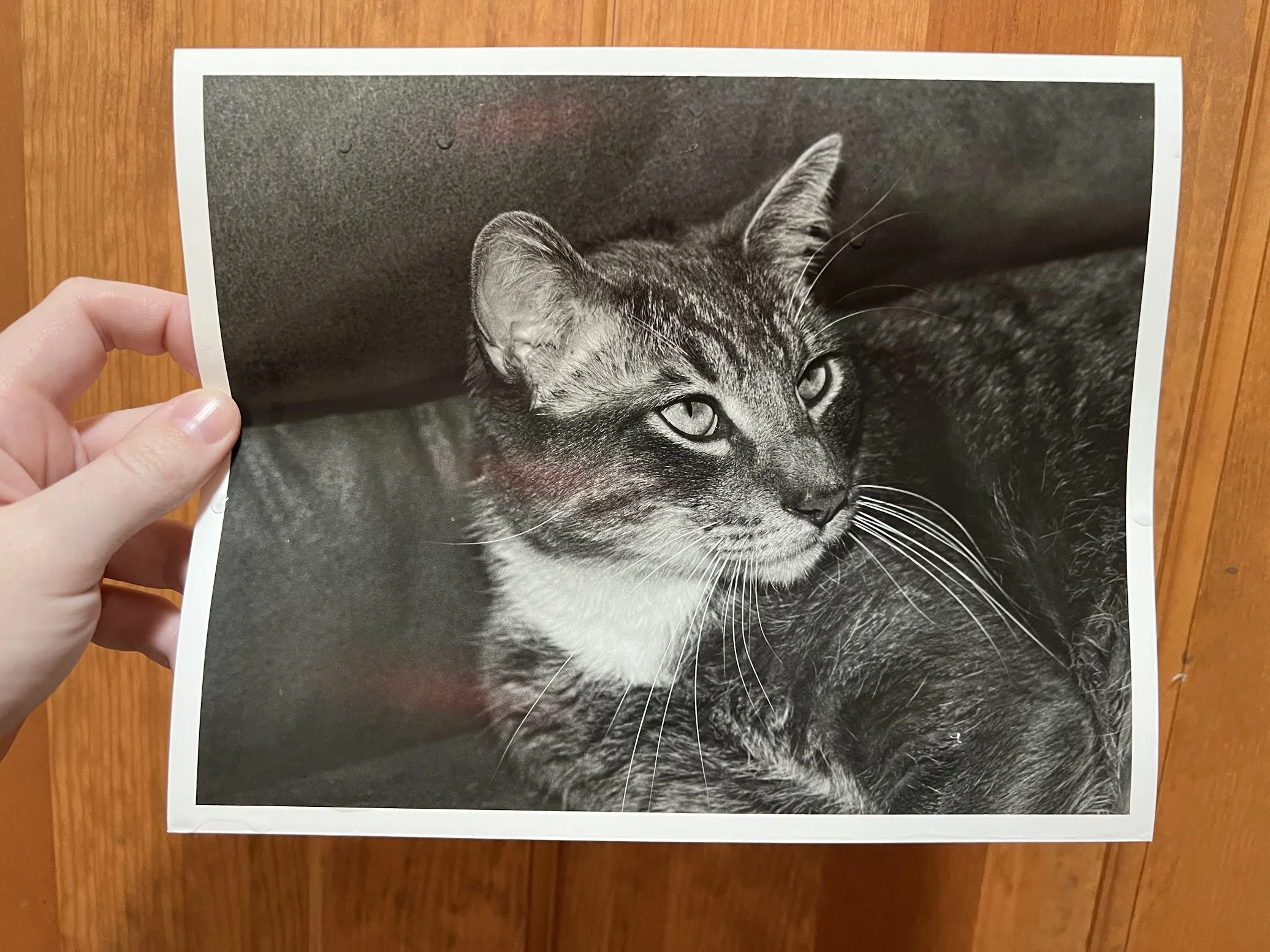
Ilford MGFB (with original GVL1 that’s 3 months old)

Curve charts (aged sample is about 1.5 months old, and used to process about 40 8x10 prints)

Fomatone RC

Foma Matte FB with very aged GVL1

In reference Tags darkroom, print developer, development
← Happy New Year! - A newsletter from Grainy VisionGVM1 - A unique film developer for pushing, portraits, and landscapes →

Search Posts

No results found
Post Archive
  • experiment report
  • reference
  • Picture Sets
  • meta
  • Photography
  • in the margins
  • newsletter
 

Recent Posts

Featured
September 20, 2026
This exists again
September 20, 2026
Read more →
September 20, 2026
February 8, 2022
Research in progress (February 2022)
February 8, 2022
Read more →
February 8, 2022
double-xx+@+500.jpeg
January 11, 2022
Happy New Year! - A newsletter from Grainy Vision
January 11, 2022

Hi everyone and happy new year! The last email was… (checks notes) almost 2 years ago, but I figured it’s time to break the silence on the newsletter front. There’s been a great number of things done and written about since the previous email, so I’ll only cover the most interesting and the most recent.

Read more →
January 11, 2022
ilford mgv rc2.jpeg
December 16, 2021
GVL1 - Long Lasting Warmtone PQ Print Developer
December 16, 2021

Today I’m introducing an unexpectedly successful developer. I mixed this up just kind of guessing at ratios and just wanting to see what a dilute PQ print developer could do. The actual end result is a formula somewhat reminiscent of ID-78, a warmtone print developer formula created by Ilford, but with notable differences. The end result is a developer with a surprisingly good shelf life, tray life and contrast consistency across its life span. It also is a fairly unique developer producing warmtones which are resistant to going olive colored, instead it will go toward brown tones.

Read more →
December 16, 2021
GVM1 - A unique film developer for pushing, portraits, and landscapes
December 15, 2021
GVM1 - A unique film developer for pushing, portraits, and landscapes
December 15, 2021

Lately I’ve been doing more regular darkroom printing and this has left me in a bit of a slump. Although I love many of the developer formulations I’ve made, they’ve often not been designed explicitly for darkroom printing. EXG1/GVG1 would produce excellent negatives with increased speed, fine grain, etc… but in the darkroom it was often very difficult to get everything on the negative onto the paper without resorting to lith printing. This problem was only slightly improved with GVK1. GVK6 (yet to be published) has significantly improved this problem, but these developers also reflected the time in my life at which they were formulated. I was doing almost exclusively lith printing and with early ModernLith formulations I needed extended scale and moderately high contrast negatives… So GVK1 specifically was formulated with this aim. EXG1 was formulated when my main priority was getting the best scannable negative, which also benefits from a long density range. And now, I’m doing regular darkroom printing a lot, so it calls for a developer with a new aim.

GVM1 is recommended for:

  • Extremely smoothed portraits of light skinned people in controlled light

  • High contrast landscape scenes

  • Pushing film to use it at increased speed without greatly increasing contrast

  • Taming the contrast of very high contrast materials

  • Getting all of the image detail onto a print in the darkroom without great difficulty

Read more →
December 15, 2021
November 2, 2021
Lith Printing Densitometry Placeholder
November 2, 2021
Read more →
November 2, 2021
249773816_10222235527464311_1608421339047696831_n.jpeg
October 31, 2021
BasicLith, a dead simple lith developer formula for modern papers
October 31, 2021
Read more →
October 31, 2021
October 2, 2021
Intermission is done
October 2, 2021
Read more →
October 2, 2021

©2019-2026 Auburn Rhythm